Showing posts with label policy. Show all posts

11 May 2010

I've seen the future and it's blurred: Mayor's transport vision


The mayor, Boris Johnson, has just set out his transport vision for London. "The Transport Strategy is a key part of a strategic policy framework to support and shape London's social and economic development over the next 20 years", it says here.

Here are the bits that mention bikes:

Page 3: "the pace of life can suddenly slow from one street to the next... children can grow up in safety... people can be
seen walking or cycling with no purpose other than enjoyment"

Page 4: "I want to create a cycling revolution and to make walking count – not only to help reduce congestion and carbon dioxide emissions, but also to improve the health of Londoners... I also want London to lead the world in new green technology – from electric vehicles to a new low
carbon bus and bike hire scheme"

Page 17: "Congestion on London’s roads is a huge hindrance to businesses, costing about £2bn each year. The
Mayor will implement a package of measures to smooth traffic flow and, in particular, achieve more reliable journey times. These include improved traffic control, minimising the impact of planned and unplanned events (such as roadworks and collisions)"

Page 18: "Well-designed public spaces can provide attractive places to spend time and can also support walking and cycling"

Page 19: "The uptake of physically active modes of transport will be promoted through information campaigns, travel planning, training and improved infrastructure such as cycle hire schemes, Cycle Superhighways, cycle parking provision, key walking routes and consistent wayfinding (such as Legible London). In addition, new developments will be planned in a way to increase the attractiveness of walking and cycling."

Page 20: "The Mayor recognises that feeling safe while cycling, walking, or using public transport is a very important part of the journey experience"

Page 21: "The strategy will therefore promote better balanced streets and an improved urban realm to make the roads physically safer, particularly for vulnerable users such as pedestrians and cyclists... In addition, the strategy will seek to create a culture of mutual respect, where all road users show consideration for each other"

Page 22: "Fear of crime and antisocial behaviour in deprived areas can dissuade people from walking, cycling or using public transport. The strategy therefore promotes measures to... improve the urban realm..."

Page 24: "Encouraging walking, cycling and public transport use together with smarter travel initiatives for people and goods will further reduce the environmental impact of transport in London"

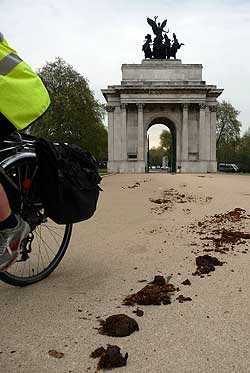
Well, erm, let's hope so. Changing the subject completely, above is a picture of Wellington Arch: something that London's cyclists go through every day. Impressive, eh?

19 February 2010

City police meeting that takes the biscuit


We had a minor success yesterday. Very minor, like, A-flat-locrian. It was the last in a series of tedious community meetings to help the City police set their priorities.

All we wanted to do was change the current City priority of 'targeting nuisance cyclists' to 'targeting nuisance road users'. We got our minor success. So now police in the City are free to go about their business enforcing the law without silly, artificial, irrelevant and divisive priorities. They can concentrate on targeting any nuisance road use, by cars or lorries or taxis or pedestrians or whoever, where appropriate.

(Maybe Lambeth police - right, on Kennington Lane - could take up the idea to target ASL infringements at dangerous junctions.)

Anyway, getting these priorities changed is boring and simple stuff. First, you turn up to the meeting. They hold them at times like 10am on a Thursday, when only mad retired locals and unemployable cycle bloggers are likely to turn up.

Then, you let the Thick Shouty People rant against pavement cyclists, red-light jumpers, bankers, paedophiles, foreigners etc. Every few seconds they run out of ideas and stop, clearly waiting for a whoop from the audience like on daytime TV. When none comes, they repeat what they've just said verbatim.

You swop long-suffering, knowing glances with the presiding copper, who listens with weary politeness. Eventually the Thick Shouty People stop, having forgotten what their point was.

Then, you suggest broadening the priorities to enable more flexible police response, or some other phrase that the TSP won't understand. The new priorities quickly get passed before the TSP realise what's going on, everyone escapes for a cup of tea and a biscuit, and there you are, job done.

Actually, the cyclists' case was made most effectively by a guy called Joe. He hadn't come to represent cyclists at all, but was there to talk involvingly about his work with the organisation Broadway, which tackles the problems of homelessness on behalf of the City.

Joe looked a bit like me - an amiably scruffy cyclist in jeans and fleece with an approachable northern accent and very good looks - but where I get snippy and irritated by the deranged interventions of the TSP, Joe is canny and calm. He smiles, gets on their side, sympathises, then smartly turns things round to make the positive case. Well, he presumably has useful experience with these sort of people.

Joe and I shared a laugh over coffee about the way you get treated when you turn up at some places by bike. The meeting was in Tower West, a fishbowl office block just by the Tower.

Wheel your bike within a hundred metres of its concourse, thronged by sharp-suited financial types, and the security guys (?Gurkhas) swoop on you. They don't believe a rainy cyclist might have proper business there. They keep trying to direct you to the postroom. And while you're waiting in the reception area reading the paper, they keep checking on you with that rude politeness particular to men with earphone spirals and walkie-talkies, and eyeing your panniers as if expecting you to whip out a dirty bomb.

And the smiling-aggressive security goons are not quite sure what to suggest about bike parking. Of course there's none outside - it might have compromised the architect's vision - so you end up being directed down a snailshell concrete helix into the basement car park, pretending that you work there. It's all rather exciting, the sort of place shootouts happen at the climax of a cliched heist movie.

Was it worth it, all this effort on a miserable wet February morning? On balance, yes: the coffee wasn't great, but the biscuits were nice.

26 November 2009

Lancet figures it out: less cars, more bikes, more eating out


The Lancet medical journal has just published a series of reports on climate change. One of them deals with the health benefits of reducing vehicle use, and a few newspapers (such as the Telegraph) have tried today to summarise their findings.

Don't believe figures you read in papers by pressurised journos speed-reading the report. They're rubbish at stats. Never get a journalist to work out the restaurant bill unless it's on their expenses. Because this report is crammed full of them, as well as tables, footnotes and caveats. It wisely gives no simple headline numbers. Wading through it is like trying to cycle up Kennington Road at rush hour with all those roadworks.

But the bottom line, unsurprisingly, is that many lives would be saved, and many more years of health enjoyed, if more people walked and cycled and fewer went by car, thanks to reductions in everything from respiratory problems to depression.

However, figures help focus the mind. And their best-case assumption, as far as I can make out, reckons on 500 premature deaths per year in London being avoided, and 7300 extra years of health per year per million population (in other words, I'm assuming, two and a half extra days of good health per person per year; I'll take it as a long weekend in July, thanks).

But don't trust my arithmetic. Read it for yourself, if you have little on at work today. (I once did a degree in maths, so I'm rubbish at numbers. I can only remember my x times table now. Never get a mathematician to work out the restaurant bill, unless the local currency happens to be pi.)

Anyway, their best-case assumes cycling increases eightfold to match that in Copenhagen, Delft, Freiburg etc. Um, right. That's a big if. Though as they point out, it's from a low start: 55% of London car journeys are under 8km, so there's plenty of scope for increasing bike trips. (They also imply that in this scenario, cycling and walking accidents might increase by up to 40%, though the rate of accidents would reduce.)

All of this, though, needs "prioritisation for people who walk and cycle, and restriction of car travel to ensure active travel is the safest and most convenient, pleasant, and quickest way to reach destinations. The reallocation of space to provide a high-quality streetscape that is designed to meet the needs of pedestrians and cyclists is of particular importance."

Oh no! If that happens we'll have nothing to blog about. And I'll end up spending more time trying to work out restaurant bills.