Showing posts with label exhibition. Show all posts

01 March 2010

The art of cycle rides: Ed Gray


We're fans of artist Ed Gray. His paintings of London nicely portray the city, as it seems to us, with authenticity and wit. Ed's a Real Cyclist himself, as you can see from the bikes he occasionally smuggles in to his pictures - see the taxi driver shouting at the one top right, and the luckless roadster toting a pothole-damaged wheel bottom right (both pictures ©Ed Gray, www.edgrayart.com).

Ed paints other cities in a similar style in countries such as South Africa, the US and Japan, which he explores by bike too. In an interview in London Cyclist magazine in 2007 (Feb/Mar issue, p42, which also featured one of his paintings on the cover), he rated his best world city cycling experience as Brooklyn Bridge into Manhattan. The worst? Elephant and Castle.

Some of Ed's paintings are on regular display in GX Gallery in Camberwell. We like this place, especially as they let us bring our bikes inside on a filthy wet day on our last visit, surely knowing that the chances of us having a grand to spare for one of their fabulous works was slim. And, from 24 March, more of his pictures will be part of a City Hall exhibition of pictures of London.


You can also see some of Ed's work at Shortwave Cinema bar and cafe in trendy Bermondsey Square, home of London's coolest bike shed. A new set of his pictures is going up in Shortwave in time for this Sunday (7 March) afternoon's ride to celebrate International Women's Day, which will begin and end at there. Parochial men can presumably just go straight to the bar.

This Sunday seems to be the start of London's public leisure-ride season. The Cycle East festival is running free gigs round various bits of the city which you are invited to ride between. The music includes gypsy, rap (which I'll be cycling away from pretty fast) and something called alt-folk. (I'm not good on genres. Is there a control-alt-prog rock? I might like that.)

28 May 2009

In search of Henry VIII


There are several Henry VIII exhibitions on right now, marking the 500th anniversary since he became king in 1509. I've been doing various things for the British Library's website for their Henry VIII exhibition, including this Google map of a bike tour taking in some Henry-related sites, and sights, in London.

Unfortunately, like the monasteries, there's not a lot of them left. Greenwich Palace, where he was born, for example, is a fabulous place to visit by bike, linked to central London by a characterful riverfront path - but Wren's magnificent old naval college you see today is a century and a half post-Henry.


View Henry VIII, Man and Monarch in a larger map


Traces of Henry's boyhood home at Eltham Palace remain in the shape of the Great Hall, but almost everything else there is 1930s (and it costs £8.30 to visit, and isn't an enticing bike ride). Syon House, a dissolved monastery in Brentford where Catherine Howard was imprisoned, is all a relatively recent rebuild.


Parts of the great Tudor Whitehall Palace, including the real tennis court, remain inside the Cabinet Office at 10 Downing St as part of a warren of secret tunnels and hideyholes. But you'll only ever see that if you become a cabinet minister. Despite Mr Cameron's kind invitation to me to stand as a Tory MP even without political experience, I think it's unlikely. There are other things higher on my wish-list, such as undergoing root canal work without anaesthetic.

You can cycle out west along the Thames Path to Hampton Court. Half of this was Henry's palace (once he'd nicked it off Wolsey) and he'd definitely feel at home there today (in fact he'd probably try to nick it back off Historic Royal Palaces). The other half is a baroque addition, which any fool can see is post-Tudor architecture. So, not the Daily Mail's picture caption writers, then. ('Looks just as regal five centuries after its construction', they say of the patently 200-year old part.) That's also a lovely ride, which you might combine with some Thames Crossings. Entry to Hampton Court Palace is £14 but you can spend a whole day there and they seem well-disposed to cyclists. They also have some temporary and permanent Henry exhibitions on.

In today's central London, though, our map has only four places that Henry would recognise: the Tower; Lambeth Palace; Westminster Abbey; and St James's Palace (above right).


Henry must have had fond memories of the Tower (right), partly because he lived here briefly after his father's death, but mainly because he had Anne Boleyn and Catherine Howard executed there (More...).

The Tower is Bloody £17 to visit, though apparently if you turn up on a Sunday and say you're going to the church service, they have to let you in free. Inside the walls, the Tower complex has the feel of a half-quaint Sussex village. We think it's a bit overrated, in the way that locals always do about tourist tick-boxes. You can feel the atmosphere from your bike without going in by cycling north across Tower Bridge. Come off right and double back on yourself to go under the bridge, then pedal-cum-push west along the riverfront path in front of the Tower.


Lambeth Palace (right), facing the Houses of Parliament, is said to be the most complete Tudor building in London you can see from the roadside.

Come in the evening when its earthy red bricks glow in the fat orange sun and then sit outside Pico Bar, down by Vauxhall Station, for a cheap and cheerful tapas dinner, and you can glow too.


Westminster Abbey (right) is very much as Henry would remember it, and he'd be delighted to see all those dead people inside. He married Catherine of Aragon here in 1509 (and lest we forget, stayed married to her for 20 years, which these days would be long and faithful enough to be in the local paper).

To go inside costs a whopping £15; if you just want the atmosphere, wander with your bike through the alley of Dean's Yard, behind the grand facades on the south-west side, into the Oxbridge-college-like quad of the school behind. Don't expect bike parking though.


St James's Palace (right), round the corner from Buckingham Palace, is still officially a 'working palace'. If that's work, Harry and Will, I wouldn't mind doing it for a living. Its main gate on Pall Mall (right) is pretty much as it was when Henry had this as one of his 54 second homes; his expenses claims have kept historians amused ever since.

Round the side (very top right) is a picturesque lane that gives you the idea of what cycling would have been like in Tudor times. However, the sporty, slim young Henry happily used to spend eight or nine hours out hunting on his horse, so he would probably have been a road cyclist rather than a tourer.

22 May 2009

Wild about free exhibitions


London's full of excellent free stuff, and usually the best way to enjoy it is by bike. One of our favourite freebies at the moment is Wild Poland, an outdoor exhibition of fabulous wildlife photos along the riverside at Gabriel's Wharf (between the South Bank and the Oxo Tower). Any exhibition you can cycle through is worth a detour and you can go at any hour of day or night (as I did early this morning on the way into work). It's on until 7 June.

A few yards downriver in said Oxo Tower is the the.gallery, which runs free exhibs too. The current one (until 31 May) features classic 1970s rock album covers by Pink Floyd et al - yes, including the 'burning man handshake' on Wish You Were Here and the prism on Dark Side of the Moon. Much of it, frankly, looks a bit lame and airbrushed now we all know someone who can Photoshop the boss's head seamlessly onto a picture of Michelangelo's David in their coffee break; Genesis's Lamb Lies Down on Broadway is one of the few that holds its own.

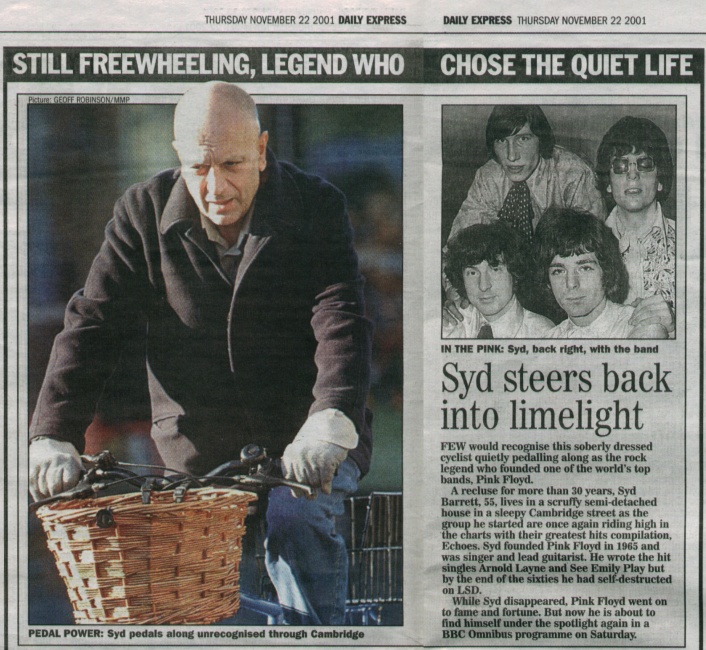
No bikes in this exhibition, though. You'll have to lock up just outside, and neither is there a mention inside of Pink Floyd's whimsical Syd Barrett song Bike. A recluse in his later years, Barrett was nevertheless a Real Cyclist: both the bicycle of his song, and his own bike, had a basket and bell, and - like many in Cambridge, England's cyclingest city - he had no need for a helmet. But then it could be pointed out that Syd had never taken much care of his head's contents.

21 January 2009

Taking Liberties exhibition cycle tour of London

I'm currently working at the British Library, editing the website of their exhibition Taking Liberties, the 900-year struggle for Britain's freedoms and rights.

This has involved taking several dozen pictures of London sites associated with exhibition items. The shop where Thomas Paine's Rights of Man was sold in 1791, for example; the house of feminist pioneer Mary Wollstonecraft; or the building where the committee for the abolition of the slave trade first met in 1787.

The stop-start process of snapping all these locations, many of them in central London or the City, would have been unmaginably tedious by public transport, with lots of foot-slogging and Oyster-bashing. And by car it would have been impossible. But on a bike, the process was great fun, taking me through lots of Dickensian lanes and passages, and to little enclaves I'd never otherwise have seen.

And gloriously expanding my knowledge of back-alley pubs. For instance, just down the lane from where the worthy abolitionists first met in 1787 is a pub called the Jamaica Wine House (top right), ironically then a meeting-place for the slave-ship masters. It's virtually unchanged from those days, except for a fresh lick of paint, a new front door, and everything inside.

And visiting by bike is the best way to enjoy the psychogeography of these sites and their contribution to history. So I've put some of my favourite Taking Liberties sites on this Google map, and sketched out a suggested cycle route to thread them together.


View Larger Map
There's a large picture for each site, and a link to the relevant item in the Online Exhibition.

I've only chosen central London locations, and any one-way streets used assume you're going clockwise overall. There are many other locations on the exhibition website's various Google maps.

For example, Magna Carta fans might be interested in cycling out virtually all along the river on the Thames Path to Runnymede, perhaps coming back from Windsor by train. En route you might pop in to St Mary's church by Putney Bridge: the site of the Putney Debates of 1647, where following the overthrow of Charles I, the people discussed what the new Republic of England should be like, and what should be in the British Constitution. Being Britain, that's still at the committee stage.

Further afield, there's one of the caves that claims to be the one where Robert Bruce had his encounter with the spider (top right, accompanying our various exhibits on Scottish independence).

I was there in autumn last year with my chums Mark and Si, cycling from Carlisle to Edinburgh one weekend. We were cycling in Dumfries, just past Gretna, through the village of Kirkpatrick Fleming (which put me in mind of Kirkpatrick Macmillan, the man who didn't invent the bicycle). I saw a sign to the cave, and couldn't resist the diversion.


Mark and I scrambled down the muddy path to the entrance of the cave (top right). It is man-made, hollowed out of the rock halfway up a cliff-face as a hidey-hole for treasure. Now there's a wooden access walkway. Our luck was in: the original spider's web was still there (below right).

I was delighted, partly because I'd seen the historic spider, but mainly because I could legitimately take a picture for the website and thereby make the whole weekend tax-deductible.